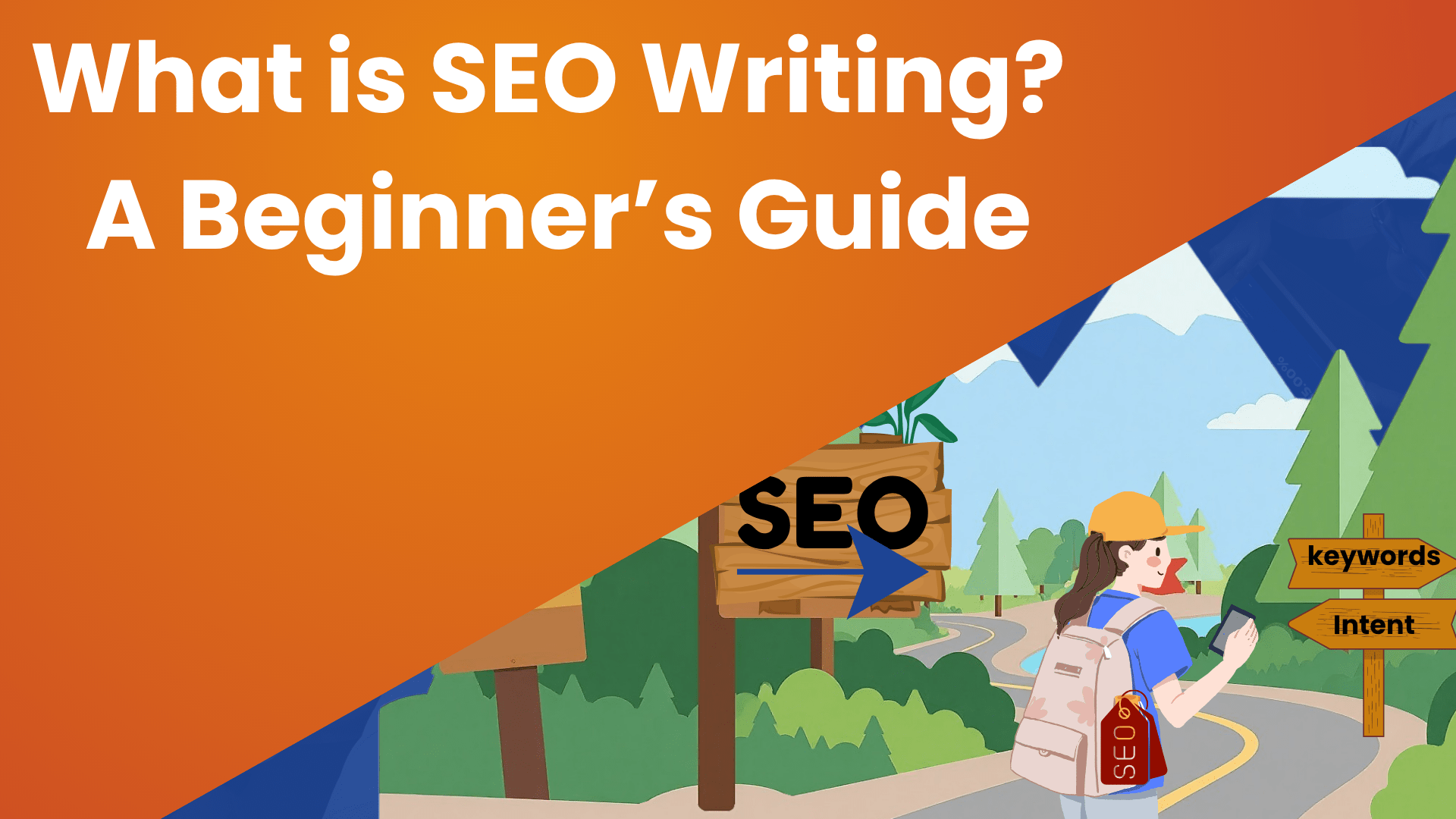
The main objective of every website is to rank on the first page, or at least on the 2nd or 3rd page, of Google. When was the last time you searched for something on Google and clicked beyond the 2nd or 3rd search result page? The further you go in search results, the less relevant the internet becomes. But what makes the content of a few handful of websites appear on the first page of search results? That’s where SEO writing comes in.
SEO writing isn’t just confined to putting your ideas into words; it’s about delivering what the search engine and readers want. If you search for a keyword like “How to Lube your Bike Chain”, you will find the most optimal and easy-to-follow content that answers your question right away. Such content is also search-engine-optimized so that algorithms notice it and put it right in front of users.
So, we can say that SEO writing is about understanding both the algorithm and the audience and then optimizing your content accordingly. From using the right keyword to understanding your reader’s intent, SEO writing content covers everything necessary to make your content noticed.
Table of Contents
What is SEO Writing?
In simple terms, SEO writing is about optimizing your content for both search engine algorithms and your audience. Just writing it for algorithms, like stuffing your content with keywords, or writing it for the audience, like just inundating your content with information, won’t take you anywhere in the realm of SEO writing; you will have to keep a balance between both.
In the end, search engine algorithms also prioritize those contents that are relevant to the readers, so while keeping the balance, you will not be sailing in two boats. It will be the same boat, with two compartments that complement each other, and you just have to maintain the balance.
So, on the one hand, your content needs to be engaging, informative, and valuable to readers, while on the other hand, it should be optimized for algorithms so Google can understand and rank it. This is the real content writing meaning.
Why does content matter so much in SEO?
Content is the medium through which every website and account communicates with its audience online. For example, if I am a terrace gardener who discovers that a specific fertilizer boosts tomato plant growth and wants to share it with the world, how would I do it? Through content, whether it’s a video, blog post, or just a Tweet. Similarly, if I started a business of economical laptop chargers, how do I tell others about it? Through online content. This is why you must have heard the phrase “Content is the king.”
But do you think that just inundating the internet with content is enough? No, you must understand what the audience is looking for, how Google ranks content, and how your content will add value to whoever consumes it.
It’s like just because someone loves to read doesn’t mean you should throw 20 random novels at him and expect him to be thankful to you. You need to understand which genre he loves, who is his favorite author, what is his current mood, and then pick 3-4 of the finest novels that will fit like a glove in his current needs.
What is the difference between content writing and SEO content writing?
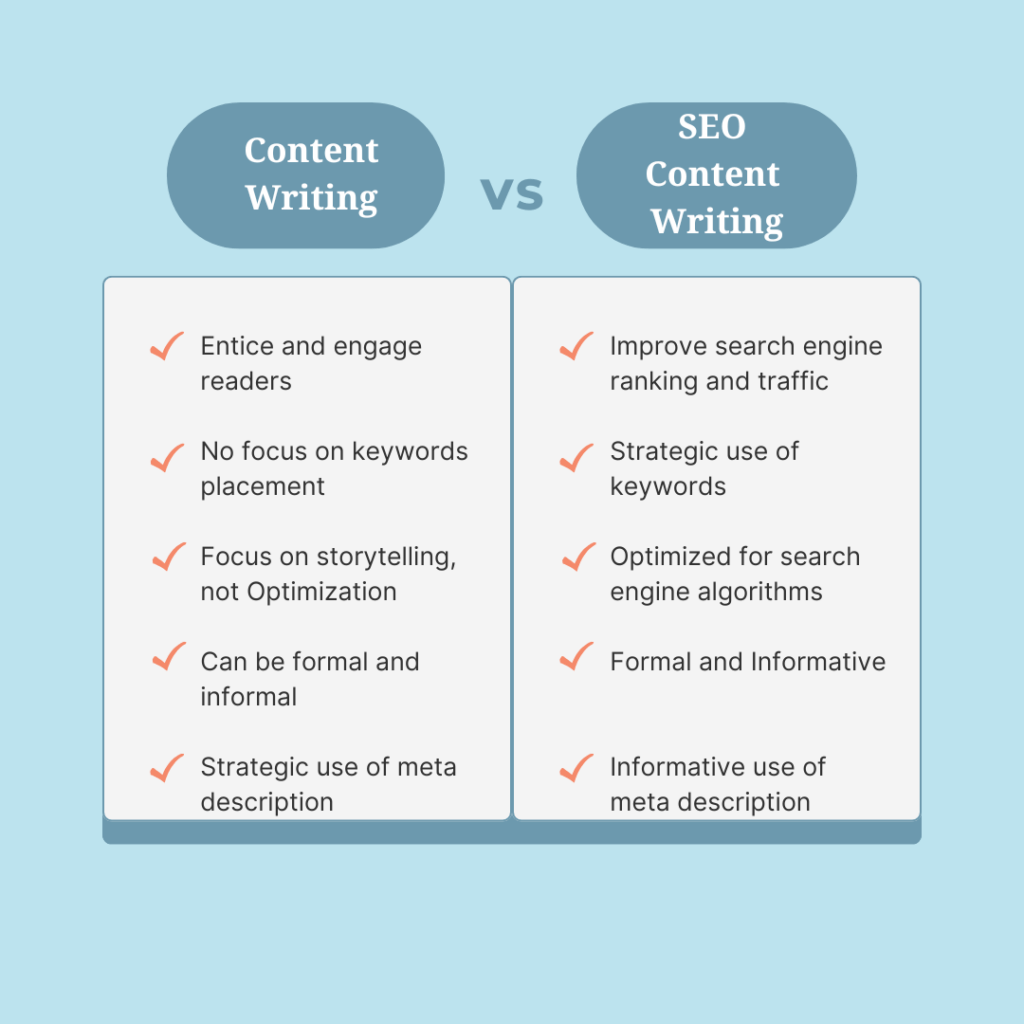
The main objective of showing you the difference between content writing and SEO writing is to make it clear that both are the two wheels of the same bicycle; you need both wheels to move forward.
If you focus solely on SEO content writing and ignore informing and engaging readers with informative, seamless content, you won’t succeed. Similarly, if you only write informative and engaging content without the proper use of keywords, meta descriptions, and alt text, search engines will never find your content, even if it is useful for the readers.
We can understand this better with SEO content writing examples. If you are writing a blog post on “How to write an SEO blog post” and focusing on SEO content writing, you will use the keywords “SEO blog post” strategically in the article. You will also bring in secondary keywords such as SEO blogging and SEO writing, and make sure the keyword appears in the meta description.
But when you write without SEO in mind, you will focus on making the article informative and valuable to readers, so they get what they came to the internet for. This is why the best approach is to take care of both the search engine and the readers.
Essential SEO Terms Every Content Writer Should Know
Keywords – These are the words or sentences that people use in the search engine to find information. For example, if you search for “budget-friendly laptops”, this will be the keyword.
Search Intent– The motive with which you search for something on the internet. It can be for researching before purchasing something (commercial), buying something (transactional), finding information (informative), or finding a specific webpage (navigational). Examples are: Informative (What is AI), Commercial (Best laptops 2026), Navigational (YouTube), Transactional (Buy iPhone 13).
Meta Description– It is an HTML tag that appears below the title in the search engine results. It should ideally be no more than 160 characters.
Alt Text – Text that helps search engines understand what the image is about. It can be added while adding an image to your blog, article, or any other form of content.
Headings – Structure of your blog post. H1 is the main title of your content, H2 is the subheading, H3 is the sub-section, and so on.
Keyword Density– How many times keywords have appeared in your content.
Internal Linking– Linking to a page on your website with another page, or linking one blog post to another with the help of hyperlinking.
External Linking– Linking your blog or website to someone else’s website. But the website you are linking to should have authority, trust, and credibility.
How to optimize your blog for search engines?
There are various aspects of search engine optimization to keep in mind, but since we have designed this guide for beginners only, we will cover only the basics. This will not complicate SEO, and you will be off to a good start.
Let me be very clear and honest: You can’t learn SEO writing through a single blog post, no matter who writes it. But you will have to start somewhere, and this guide is a good, easy, and solid step towards your journey into SEO content writing.
Find a topic using keyword research
At first, keyword research might sound like the final boss of search engine optimization, but it’s not. Use a free SEO tool, such as Ubersuggest, Ahrefs, or Semrush, for keyword research. Watch a basic video of how to do keyword research on these tools, and it will not take you more than 10-15 minutes to go through the basics. Let’s understand this with SEO content writing examples.
If you are writing about aquarium fish, you can search for keywords like “Aquarium fish food” or “Betta fish care.” Now, after choosing the keyword, you will get metrics like keyword volume (how many people search for that keyword) and keyword difficulty (how easy or difficult it is to rank for that keyword). For your initial phase, choose a keyword with a volume of at least 500 and a keyword difficulty between easy and medium.
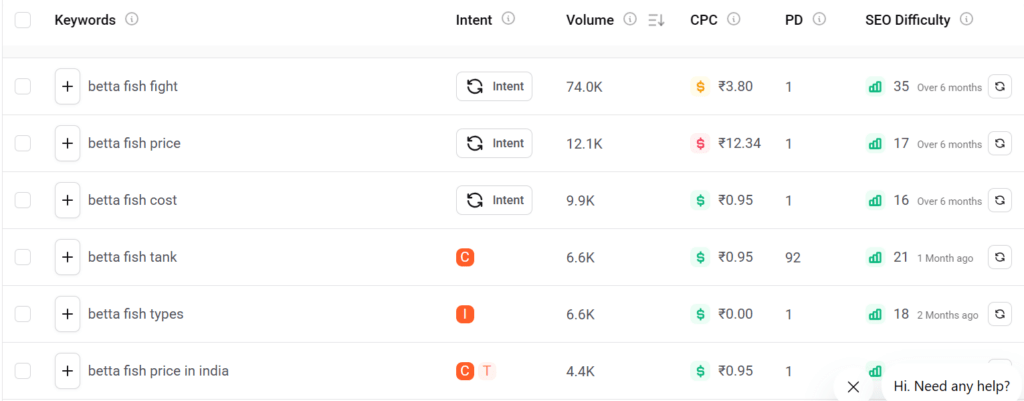
Keyword placement– Now that you have chosen your keyword, make sure the keyword appears in the introduction of your blog, and the keyword density shouldn’t be more than 1.5%. Use it naturally in the blog so that it doesn’t feel like someone put cherry in a turkey. Also, make sure to use the keyword in the meta description, title tag, URL, H1 tag, and H2 tag.
Keep search intent in mind
Even before you write the first word of your article, you will have to be clear about the search intent. In our case, you are writing about “Betta fish care,” and people will use this keyword to find information. No one will type “Betta fish care” in Google if they want to purchase it or visit a specific website. This means the search intent is “informational”. But what does it mean to you?
When you are clear about search intent, you can write content accordingly. It’s like when you know what the customers sitting at the table like, you can cook your dish accordingly. In our case, you will provide detailed information on how to care for betta fish. And, thus, the audience will get what they were looking for from your blog, and you will rank better.
Make the most of meta descriptions and title tags
Although neither the meta description nor the title tags directly affects SEO, they are the first things a user sees in Google search results. It’s like the building and main door of a restaurant that people see, and that makes them visit the place. No one can smell or taste your food from the road, but you can make them curious to enter your place through your main door (meta description) and building (title tag).
Use a unique meta description that encourages your audience to click your blog. In case of “Betta fish care” blog, you can write “Give your betta fish the care it deserves. I have 200+ betta fish, and a few tips can transform your betta fish care aspect.”
You need to do the same with your title tag. For a “Betta fish care” blog, you can use a title “Top 10 things people don’t know about Betta fish care”. This will make people curious and force them to click your blog.
Write comprehensive content
The average length of blogs in the top 10 search results is around 2450 words. But this doesn’t mean you should increase the length of your blog just to meet word count goals. You should publish content that covers the entire topic on a single page.
No one likes to jump from one article to another just to get information. That’s why you should make the visitor stay, read, and leave without feeling the need to go anywhere else for the same information.
Use External and Internal Linking
When you link a section of your blog to someone else’s website, you’re telling Google that this content comes with proof and data readers can rely on. External linking also enriches the user experience, as SE Ranking explains. And just here, I added an external link to SE Ranking that people can click to learn more, while Google will recognize this blog post as reliable and credible.
Similarly, when you link your blog to other blogs on your website, you keep readers on your site longer, giving them more information to consume, and Google sees it as a positive sign that readers are staying on your site for a long time.
Other SEO factors
Make sure to add alt text to the image you use on your blog. It helps you describe your image to Google, and if possible, use your keyword in the alt text. Also, keep updating your content to keep it meaningful for the audience. A blog published in 2010 on “Betta fish care” might not be valid today, as the aquarium, people, and fish food have changed.
Conclusion
Content writing alone won’t get you anywhere, and the same goes for SEO writing. The one who succeeds in the neck-wrenching competition of content balances both. On the one hand, you have to ensure readers leave your blog with a smile of satisfaction, while on the other hand, you have to let Google know your content is worth ranking on the top page. So, begin your SEO writing journey today and keep both algorithms and your audience satisfied with your words.
SEO content writing FAQs
Which tools can I use for SEO writing?
Best tools for SEO writing are Ubersuggest, Google Keyword Planner, Ahrefs, Semrush, and Yoast SEO. These tools can help you in your SEO writing journey. You can use the free version of these tools if you don’t want to pay.
What is keyword stuffing?
The maximum keyword density should be 1.5%. This means, in a 1000-word blog, your keyword shouldn’t appear more than 10-15 times. When you overuse your keywords in a blog post or article, it becomes keyword stuffing, which can trigger Google penalties and reduce readability.
Is learning SEO necessary for content writers?
Yes, SEO helps content writers to write what ranks on Google. But it’s not necessary to become an SEO expert. You just need to optimize your content so that you get discovered online. Use a mix of storytelling and optimization to perform better.
What is mobile optimization?
What you are writing will be viewed on mobile. So make sure to optimize your content for mobile screens as well. Limiting paragraphs to a maximum of 4-5 lines, prioritizing fast loading time, using clear language- all these are part of mobile optimization for SEO writing.