Did you know that a reader takes just 0 to 8 seconds to decide whether they will read a blog or not?
And on what basis does he decide to accept or reject the blog? Obviously, the introduction. You have to grab the reader’s attention in these 8 seconds; otherwise, you will lose them. This is why so much emphasis is given to the blog’s introduction.
A good introduction can elevate average blog post content to a better ranking, but even the finest blog post content can never rank if it has a poorly written introduction.
But what is a good example of a blog introduction? What does it take to write a compelling introduction? Is there a formula to write the introduction? Let’s unravel all these mysteries.
Table of Contents
10 Blog Intro Examples That Grab Attention
To make you understand the examples clearly, I am going to use the same topic for every example. This way, you can know how the intros vary for the same title.
Title: How to Write A Blog Post?
1. Question Hook Introduction Example
What does it take to write a good blog? Some people might say it’s the title, while other priortize the blog’s structure. Well, an engaging and informative blog covers many aspects, delivering a piece that deserves to be read and ranked.
You can’t just optimize your blog for SEO and ignore the reader, or just focus on the blog’s structure and skip making it informative. A perfectly crafted blog includes every aspect in balance, and you will notice this balance in all the blogs ranking on the first page of Google Search results.
So what does it take to write for both readers and search engines? Let’s find out.
Analysis
This is a good example of a blog introduction that starts with a question hook. Now, what is a hook? It is the first attention-grabbing sentence of your introduction.
Why it works?
- Triggers the mind into finding an answer instead of just passive reading. Thus, the reader moves from the hook > answer > blog post content.
- Makes the reader think about a problem they have never considered before.
- Challenges common belief. Like, if I start a blog post with a question hook: “Should meta description include your primary keyword?” This will challenge the common belief that the meta description should always include the primary keyword.
2. Statistics-Based Introduction Example
Out of the 600 million blogs published, 96.55% of the blogs never get any traffic from Google. One of the main reasons why such a staggering number of blogs perform poorly is that they aren’t written for both SEO and readers.
Some blog posts are so heavily optimized for Google that they become a scramble for readers. While others are are laser focused to readers only, and that’s why they never rank.
The key here is to strike a balance between SEO and writing for readers.
Analaysis
Such blogs start with stats related to the topic. Make sure the stats are not overwhelming and are legitimate. Write it in the simplest form possible.
Why it works?
- Creates a shock in readers’ minds, breaking the usual statement-introduction cycle.
- Builds authority and assures the readers that the person writing the blog knows about the topic.
- Creates questions like “how” and “why” in readers’ minds, and the mind demands answers to these questions instantly.
💡Important: Link back to the website from which you obtained the stats.
3. Quote-Based Introduction Example
“Don’t focus on having a great blog. Focus on producing a blog that’s great for your readers.” – Brian Clark
This is what modern bloggers need to focus on in an era when everyone is talking about the importance of SEO optimization.
Whether it’s about providing the exact solution or information to the reader or making the blog easily readable with the right font and size, 60% of blog writing effort should be directed towards the reader. But then how to fit SEO into it? This is what we are going to learn.
Analysis
These intros start with a quote from a famous person. The quote must be from an expert from the same industry. Also, make sure the quote is legitimate.
Why it works?
- Makes your blog credible since the first thing a reader scans is a statement from an authoritative figure.
- Allows the reader to grasp a complex aspect of the topic through a memorable, easy-to-understand phrase.
- Readers become emotionally connected when a quote triggers brain regions that release oxytocin and dopamine, so they feel as if they are experiencing the event firsthand.
💡Important – Just search “Quotes on XYZ” on Google, and use the one that justifies your topic.
4. Storytelling Blog Introduction Example
When I started blogging back in 2016, I never used to rank. Doesn’t matter how much research I did, how I structured my blog. I used to go to the 9th and 10th pages of Google to find my blog posts, but they were nowhere.
Now, after 10 years of writing, when I look back on how I used to approach a blog post, I clearly understand what I missed.
If the present me had met the 2016 Saurabh Kumar, I would have suggested that he review the points I am about to mention here, so my 2016 self would have been able to find the published blog on the first page of Google search results.
Analysis
This type of killer blog post introduction includes a personal story. It is always a good approach to include a real personal story rather than a hypothetical one. But you can also come up with one if your writing has the power to make the reader believe it’s real.
Why it works?
- Makes the blog credible, since the writer is sharing personal experience rather than repeating the same generic statement found everywhere on the internet.
- Gives the blog a human touch that’s missing from most blogs on a faceless website.
- The reader feels connected to the blog because he might have gone through a similar situation or is going through one right now.
💡Important – Don’t write an autobiography while sharing personal experience. Keep it short.
5. Curiosity Gap Introduction Example
Most new bloggers think that writing a blog post is about making the blog informative and using the primary keyword everywhere. Well, the fact is, such a strategy no longer works, especially after Google updates like MUM, BERT, and RankBrain.
Blog post writing and ranking have moved far beyond primary keyword and informative content. You have to align your blog writing strategy with the updated algorithm and readers’ shift in how they consume content online.
Analysis
This is a blog intro sample that showcases the use of the curiosity gap. In such an introduction, the reader is teased with a desirable solution or outcome. Similar to how many YouTube Reels start “This small plant fertilizer tip changed my life”.
Why it works?
- When a reader is led to believe there is a knowledge gap, the brain starts searching for information to fill it, thereby increasing engagement.
- The reader gets hooked on the blog from the very first sentence and doesn’t want to leave the page until he finds the answer.
- Even readers who skim most blog posts get emotionally invested in the blog because they are seeking an answer or want to know when their long-held belief has been called into question.
6. Short Blog Introduction Example
Mastering the art of blog writing is necessary since a large part of getting discovered online depends upon content. So, let’s learn how to write a blog from scratch with this easy guide.
Analysis
This type of catchy blog introduction is limited to two to three lines in a single paragraph. There is just an opening hook, followed by an introduction to the blog post.
Why it works?
- Harnesses the short attention span of readers and lets the user move smoothly into the main content in just a couple of seconds.
- Since most readers are skimmers, it targets them as well. The short intro makes skimming easy and increases the chances that the reader will stay on the page.
- “Straight to the point” content is being preferred by Google as well. It also builds chances of your content appearing in the AI Overview.
💡Important – Make every word count. You have to convince the reader in just two lines.
7. Problem Solution Introduction Example
Writing a blog post sounds easy until you open your Google Docs and go blank with no idea how to begin. Many writers out there aren’t able to organize their thoughts, put them into words and provide a readable, enticing and informative blog post for readers.
This leads to writer’s block, and even a 600-word blog post sometimes takes hours to finish. Even after he is done with the blog, shadows of doubt keep hovering over his mind. But you can make blog writing simple and productive by following this easy step-by-step method.
Analysis
This is one of the most used ways to start a blog post introduction. It has three parts: the hook, which introduces the topic; the problem and its impact; and, finally, an assurance of a solution in the content.
Why it works?
- Readers can relate to their situation from the very first word of the blog post and thus feel connected.
- Laser-focused on the reader’s pain point, so he/she feels that even the writer has been through a similar situation, or at least knows about it. This builds trust.
- The impact section of the introduction evokes fear and curiosity in readers by explaining what will happen if they don’t fix the issue.
8. Expert Opinion Introduction
According to most of the digital marketers, writing a blog post isn’t only about the readers or search engine optimization; it’s about finding a balance between both. This is why the top companies never compromise readability for optimization or vice versa.
If top digital marketers are getting results with this approach, we can do it too. All you need is a simple guide to writing a blog post that strikes the perfect balance between readers and SEO. Well, that’s what we are going to learn in this blog post.
Analysis
It is a smart way to start an introduction, and you don’t necessarily have to include stats here. It can be a trend that experts can also mention as an opinion. Or facts which beginners don’t know.
Why it works?
- Makes the blog credible and trustworthy from the very first sentence by including analysis, facts, and trends from experts.
- Assures readers that there is a proven method for the solution they are seeking.
- You harness the power of authority by citing something from the experts.
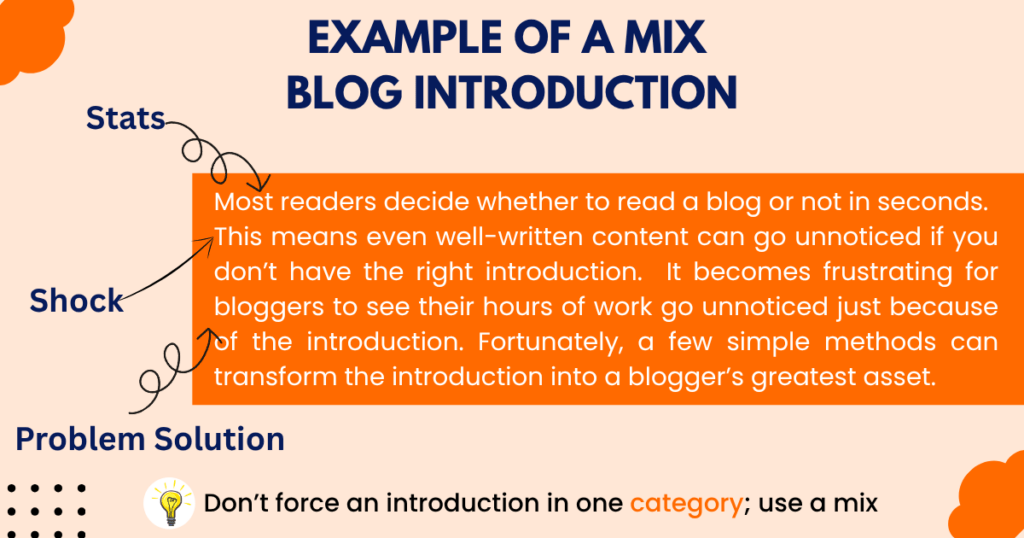
Among the many blogging mistakes beginners make, trying to force their intro into one category is the most common. You can use a mix of the above examples in a single blog’s introduction. Here is an example-
A 4 Step Formula For Writing Compelling Blog Introductions
Here, I have designed a 4-step formula for writing a blog introduction.
It’s not the only way to write a blog post introduction, just like there are many ways to optimize H1, H2 and H3. But it will make it easier for writers of all types and in every domain to get started and achieve their goals.
There are three parts of a blog post introduction: the Hook, the Base, and the Closing. Let’s discuss these parts in detail.
Harness the Hook
The first sentence of the introduction is called a hook, and do you know why it’s called a hook?
As the name suggests, it is a writer’s prime tool to catch the attention of readers just like a hook catches fish. But will the reader grab your hook if it’s not enticing? No.
Here are a couple of points you need to keep in mind while writing a hook-
✅ It should be short, not more than 140 characters.
✅ It should trigger any of the one emotions: curiosity, fear, shock, assurance, trust.
✅ Keep it to the point
✅ Use active verbs
✅ Never give the entire plot away
Build up the Base
You should write a hook in such a way that it smoothly transitions into the base of your introduction.
If the hook is the door, the base is the hallway that leads to the blog post.
And in the base, you can write about problems, experiences, solutions, risks, trends, and you can even support your hook with the base of your introduction, as I did for this blog post. But you should keep the following points in mind while writing the base of your introduction-
✅Don’t beat around the bush. Keep it laser-focused on the main topic.
✅Show confidence. Don’t use words like maybe, if possible, actually, really, I believe, I think.
✅Don’t use fillers like One of the main things, This is the main reason why, You should know and many more..
Keep it up with Closing
Many writers don’t pay much attention to the closing and write something generic like “In this blog post, we will be discussing XYZ…..”
Well, there is nothing wrong with that type of closing, as you have to give a sneak peek of what the reader will get from the blog post. But the above-mentioned method will get lost among billions of blogs out there with the same intro.
Look at how I have closed the introduction to this blog post. It promises what the reader will get after finishing the blog, but not in a generic way. You can develop your own style and hone it over time.
✅Keep it short, not more than 1-2 lines
✅Don’t give away the whole plot
✅Offer a promise while still keeping the fire of curiosity burning
Niche-Specific Blog Introduction Examples
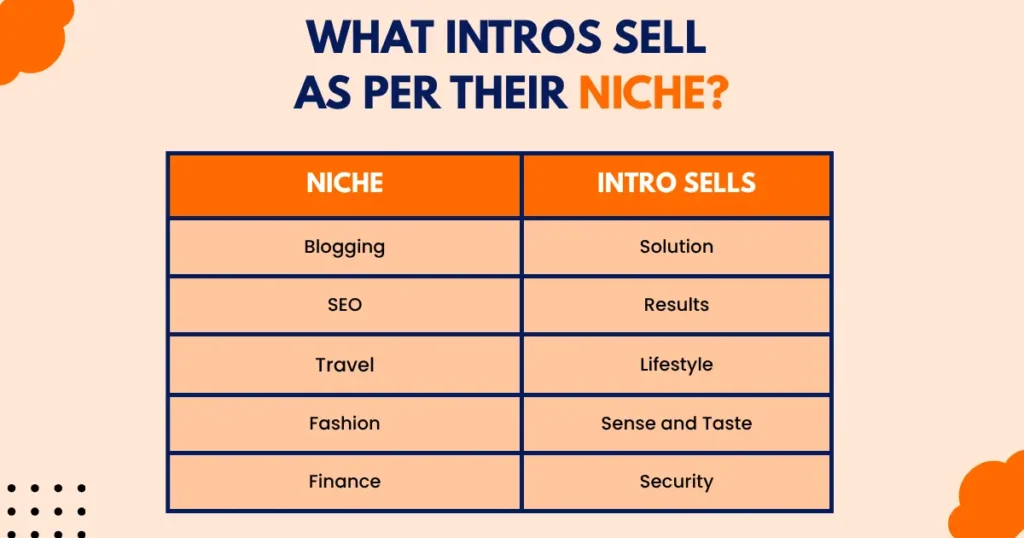
Introduction varies as per niche. I have worked for Travel, Fashion, Food, and many other niches, and a slight variation can make your intro niche-specific and better.
Travel Blog Introduction Example
Jaipur is not just another tourist destination on your bucket list. It lets you immerse yourself in India’s history, delve into its culture, and bite into its exciting food.
Also known as the Pink City of India, Jaipur is one of those cities that no one wishes to regret missing in their life. From gigantic fortresses to soothing cultural hotspots, there are so many things to do in Jaipur that you have to be well prepared and plan properly for it.
Why it works?
✅ Gives readers an instant shock and challenges their beliefs.
✅ Makes them curious from the very first line.
✅ Explains the city’s highlights in a poetic, cinematic format that triggers the reader’s travel instinct.
✅ Assures readers of what they will get from the blog post.
Well, you can use some of the formats explained in this blog post, like a quote, personal experience, a hook with a shock or fact, but here are a couple of things that make a travel blog post unique-
- You have to be creative. You can’t just write “Summers are hot in Jaipur”. You have to say “The sun is scorching during the summer, and you have to be prepared for it”.
- If you are writing your own blog post, explaining the city from your own point of view is beneficial as it builds trust, like travel vlogs. But don’t do it if you are working for a company.
- Search the city, look for its tourist destinations, and what makes it unique. Then build an introduction that makes the reader believe he shouldn’t miss it.
💡Important – Don’t write tourist destination names in the introduction.
Fashion Blog Introduction Example
Summers will soon be knocking on your door, and if your wardrobe isn’t ready to beat the heat, you better get prepared for it. But do you know how to beat the heat in style?
Every summer brings new fashion trends, and this year, they point towards vibrant colors, relaxed silhouettes, and timeless pieces. So let’s make some room in your wardrobe so that these top 10 summer fashion trends can make their way in.
Why it works?
✅ Highly relatable. Readers get hooked from the very first line.
✅ Assures inspiration and practical advice- these are the two things fashion readers look for.
✅ Builds anticipation. Which trend is the author talking about? How to beat the heat with style? Do I need to empty my wardrobe and fill it with new summer clothes?
Here are a few things which makes Fasion blog introduction examples unique
- You can’t use the problem-solution introduction in the fashion domain. It is usually based on inspiration, suggestion, style, and expression.
- Advice and trends are a big part of fashion blog introductions. So try to keep your intros around lifestyle and aspirational words.
- Never ever use stats in these intros. Nobody is looking for numbers when they are searching for trends.
Food Introduction Example
Have you ever wondered what perfectly cooked fried chicken feels, smells, and looks like?
The golden color confirms crispiness, while the juices oozing out when squeezed assure tenderness. The smoky aroma shouts that I have been cooked over coals, and the green sauce on the side is waiting for the pieces to be dipped.
Although the fried chicken recipe looks simple, only a few people can cook it properly. The small details missed in the fried chicken recipe are what take away the joy. But don’t worry, after finishing this blog post, your fried chicken will look exactly how you always imagined it to be.
Why it works?
✅ Targets the sensory organs of readers, such as smell, taste, and sight, which is essential in a food blog introduction.
✅ Makes the food desirable by choosing words that make the outcome look like something from michelin chef’s kitchen.
✅ The outcome is clear: learning the perfect fried chicken recipe. This assures readers what they will get from the blog.
What makes a food blog introduction different?
- Focus on text, texture, and enjoyment
- No quotes, no stats, and no personal experience in the introduction
- Assurance of what the reader will learn is critical
Blog Introduction Ideas When You Are Stuck
Many times, even after sitting for 10 to 15 minutes, writers aren’t able to pen down even a single word. They write something, think it’s not that good, hit backspace and start again.
This is a common problem among writers, and it usually happens when writers don’t have new or enticing blog introduction ideas. In such a situation, you can use this cheat sheet.
✅Start with stats
✅Ask a question
✅Start with a mistake
✅Share your personal experience
✅Start with a prediction
✅Start by challenging the common belief
Introduction is the most difficult part of writing a blog post. Yet, when mastered, it can become a writer’s weapon. With a good intro, a writer can make even an average blog post work both for readers and Google. This is why introductions should always be carefully crafted to meet both the reader’s expectations and the search engine’s ranking factors.
FAQ
How do I start an introduction for a blog?
Start with a hook which capture reader’s attention in a couple of seconds. Then move to the body, which should justify the hook and focus on problems, challenges, impact, current situation, or gap. Then, finally, close the introduction with an assurance of what the reader will get by finishing the blog.
How long should a blog post introduction be?
It shouldn’t be more than 100-150 words. The longer the introduction, the more the reader will have to wait to get the juice of the blog post. This can lead to higher bounce rates as no one will move beyond the introduction.
What are some common blog introduction mistakes?
Here are some common blog introduction mistakes-
- Writing a long intro
- Talking about everything else instead of the main topic
- Not using a hook
- Not keeping the reader’s interest in mind while drafting the intro
- Putting too many stats
- Not mentioning the main content of the blog
- Using words like I believe, possible, maybe which shows a lack of confidence
Can a blog introduction be of one paragraph only?
Yes, even top-ranking websites like Ahrefs and Semrush use a short, single-paragraph introduction. It gives instant access to the main content, which is rewarding for the readers.