
E-E-A-T has been part of SEO professionals’ toolkit since 2014, when Google introduced E-A-T in 2014 through its Search Quality Rater Guidelines. But is keeping the same old E-E-A-T structure in your AEO strategy relevant?
We all know AI models like ChatGPT, Claude, and Perplexity scan and cite content differently than how Google shows it on the first page. So, can putting hours into building strong E-E-A-T for your website or content help AI cite you?
If not E-E-A-T, how do AI models decide which content to trust, and what changes do you need to make to your existing E-E-A-T strategy to satisfy both search engines and AI models? Let’s find out.
Table of Contents
DOES E-E-A-T Matter for AI Search?
AEO strategies may need to account for how different AI platforms retrieve information and select sources. For example, Google’s traditional search ranking is closely tied to how AI Overview cites content compared with how ChatGPT cites it, according to Ahrefs’ research.
The same goes for E-E-A-T. Although Google clearly mentions E-E-A-T in its content evaluation guidelines, that doesn’t mean other AI models like ChatGPT, Claude, and Perplexity use the same guidelines.
But any system on the internet that retrieves information and shows it to users needs to verify that the content is trustworthy, reliable, and useful because its reputation depends on accuracy. However, over the years, different AI system have built their own ways of verifying it.
That’s why it’s important to first look at what Google and other AI companies have disclosed about their systems and how they check a content’s reliability and trustworthiness.
What Google Says About E-E-A-T?
E-E-A-T is a concept Google’s human evaluators (search quality raters) use to rate a webpage’s quality.
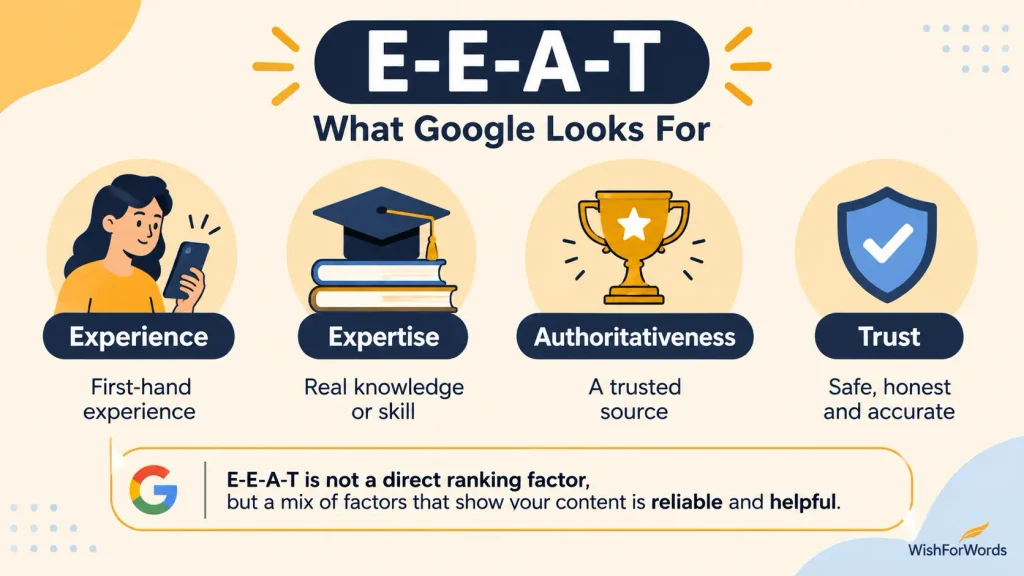
Google’s Search Quality Rater Guidelines clearly mention Experience, Expertise, Authoritativeness and Trust (E-E-A-T) as one of the important considerations when rating a webpage. Among the four pillars of E-E-A-T, trust is the most important.
Here is what Experience, Expertise, Authoritativeness, and Trust mean, according to Google’s search quality rater guidelines.
Experience– Does the content creator have first-hand or life experience of the topic, like personally using a product or service, facing a challenge, living through an event, or been through a situation.
Expertise– Does the content creator have the necessary knowledge or skill for the topic? For example, does he have professional qualifications, academic knowledge, specialized skills?
Authoritativeness– Is the webpage or the content creator considered a go-to, reliable, and trustworthy source of information for the specific topic?
Trust– The extent to which a webpage is safe, honest, reliable, and accurate. (Trust matters the most because a page that can’t be trusted is rated low regardless of how experienced, expert, or authoritative it might seem).
As per Google’s documentation, E-E-A-T is not a direct ranking factor; rather, Google uses a mix of different factors that together showcase how strong a webpage’s E-E-A-T.
Does AI Overview use E-E-A-T?
Google’s AI feature and your website documentation say that to appear in AI answers, one can use the same foundational SEO practices it uses for Google Search. And one of those practices is creating helpful, reliable, people-first content, which is connected to E-E-A-T.
This means Google has indirectly said E-E-A-T is one of many factors it considers when deciding whether to cite content.
Even in Google’s Optimizing for Generative AI documentation, Google says generative AI features on Google Search are deeply rooted in core search ranking and quality systems. The same document says that Google’s AI model uses a RAG system to retrieve relevant, fresh, and up-to-date content, and this RAG system relies on Google’s Search Ranking system.
Many other studies and stats say the same thing about AI Overview using E-E-A-T to choose credible sources to cite.
- Research by Wellows showed that 96% of AI Overview content comes from sources with verified E-E-A-T signals.
- Ahrefs’ latest study revealed that 38% of the cited AI Overview pages rank in the top 10 search results. This establishes the relationship between basic SEO and AI citation. Since E-E-A-T is part of basic SEO, it also supports AI citation.
- A study by SEOClarity found that 94% of AI Overview citations included at least one URL from the top 20 search results.
Do AI Search Engines Use E-E-A-T?
AI search engines like ChatGPT, Perplexity, and Claude have not publicly confirmed that they use Google’s E-E-A-T framework to evaluate content or decide which sources to cite. However, research and official documentation suggest that some E-E-A-T principles overlap with the mechanisms these platforms use to retrieve, process, and reference online information.
In my research into how AI search engines retrieve and filter content, I found no official documentation from OpenAI, Perplexity, or Anthropic confirming the use of Google’s E-E-A-T framework. Their documentation does, however, provide insight into how these platforms find, process, and reference online information.
Official Documentation
ChatGPT
ChatGPT’s closest official documentation regarding trustworthy content is limited to only a single sentence in OpenAI’s official Help Center, and it says
“ChatGPT ranks search results using multiple factors intended to help users find relevant, reliable information”.
However, OpenAI has never disclosed which factors it uses to determine relevance and reliability.
Perplexity
Perplexity’s Architecting and evaluating an AI-first Search API reveals how it discovers, understands, and ranks web content. It states that the system prioritizes authoritative domains for indexing and content quality for extraction, relevance during retrieval, and freshness during filtering. This makes content quality, authority, freshness, and relevance important.
Claude
Claude 2’s official documents, Citation and Web Fetch Tool, tell us that clear source attribution, accessible supporting evidence, and verifiable information are important factors that make information easier for Claude to reference. But these are not direct ranking factors.
Studies and Stats
Experience & Expertise
- Neil Patel’s study on which content type AI cites reveals that original research ranked first at 82% for AI citation. And obviously, original research requires experience.
- Research by Clipper Ship Marketing highlights that trend, and analysis content earns citations from large language models 78% of the time. Trend coverage and analysis require both experience and expertise.
- Neil Patel’s another study suggests that including first-hand experience is one of the 5 factors that helped content perform better than blunt outputs. And first-hand experience is directly related to experience.
Authoritativness
- Ahrefs’ study shows that branded web mentions correlated at 0.664 with brand visibility in AI Overviews. This external recognition points to authoritativeness.
- A 2026 study by Kevin Indig found that brands dominating AI-generated mentions in their respective categories had 52.5% higher Authority Scores
Trust
- The Tech GEO paper revealed that adding citations, quotations from relevant sources, and statistics lifted source visibility by over 40%, with GEO methods reaching up to 40%. This signals the trust factor.
What Do These Findings Tell Us About E-E-A-T in AEO?
The central finding of our research on E-E-A-T and AI search engines is-
- ChatGPT emphasizes relevance and reliability.
- Perplexity discusses content quality, authority, freshness, and relevance.
- Claude’s documentation mentions source attribution and evidence traceability.
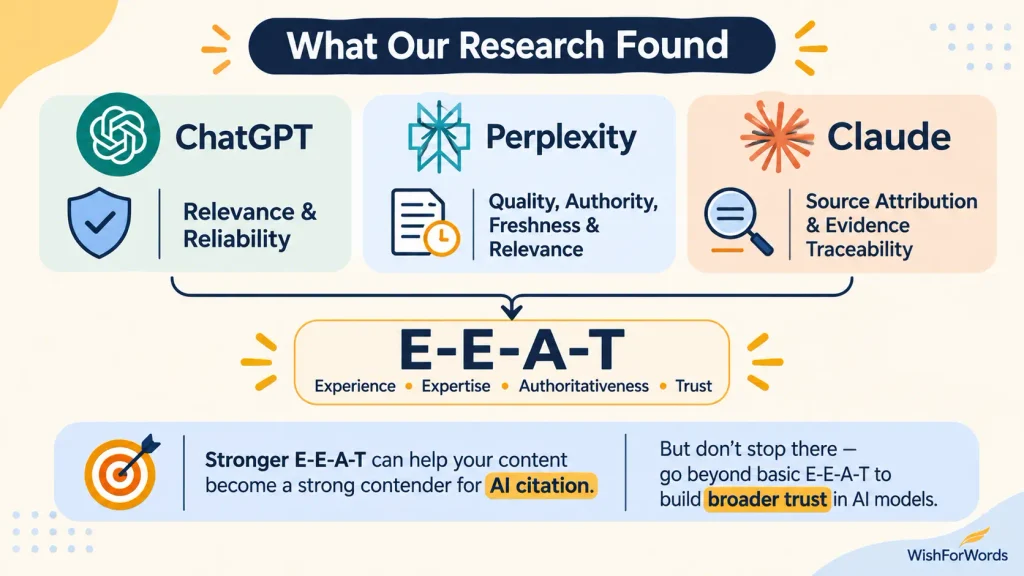
As you can see, many of these concepts overlap with the E-E-A-T framework; if you build stronger E-E-A-T, your content can become a strong contender for AI citation. But you have to go beyond a basic E-E-A-T strategy to cover the broader spectrum of building trust in AI models.
How to Build Trust for AI Search Engines?
Based on Google’s E-E-A-T framework and our research on AI search engines, we built a strategy to help you build trust in AI search engines.
1. Showcase First-Hand Experience
Write about real-life experience instead of publishing what’s already available on the internet. For example, include product reviews, your own analysis, findings, lessons you learned from a certification or project, life situations you’ve been through, and more.
2. Support Claims With Reliable Sources
Instead of writing only opinions and generic statements, support your claims with credible sources. This increases your content’s trust signal. Make sure to use reliable sources for citations and never forget to hyperlink them in your content.
3. Get Mentioned
Get mentioned by third-party platforms, whether it’s someone else’s blog, social media handle, press release platform, or YouTube video. AI uses these third-party signals to understand how authoritative your website, profile, and content are.
4. Maintain Freshness
Make a habit of checking content that includes stats, claims, technology, trends, and products. They can change over time, so update them to stay fresh. That’s how you make sure your content is reliable.
5. Practice SEO for Ranking
Whatever SEO practices you are implementing to improve your search engine ranking, keep doing them. Your search engine ranking plays a key role in AI citation, especially in Google’s AI Overview.
7. Establish Clear Author and Website Identity
Your website’s About Us page and your author bio should be clear and relevant. Make sure it’s easy to understand for readers what your website is about and who you are. Include your expertise, experience, and skills in your author bio.
E-E-A-T must be part of your strategy, whether you are trying to rank in search engines or get cited by AI models. How you practice E-E-A-T may need to expand and evolve across platforms. And if you already have an AEO strategy in place, make sure to include E-E-A-T in it because AEO ensures your content can be understood by machines; E-E-A-T ensures that it is trusted enough to be recommended to humans.