Every guide on “How to get cited by AI” has one common suggestion: write short paragraphs for AI citation. Some will recommend a 60-word paragraph, while others say 150 words. The problem is that none of them explain how a short paragraph helps with AI citation.
AIs aren’t like humans, and they don’t randomly prefer one content structure over another. A whole system of different models, calculations, and methods makes AI pick one content structure over another.
“The secret to getting cited by AI lies in understanding how AI works”
What does research analyzing millions of prompts say about short paragraphs? Is there evidence supporting the 60-word paragraph theory, or is it just another assumption? This is what I’ll reveal in this article.
Table of Contents
How AI Systems Retrieve Your Content?
When someone asks ChatGPT, “What are the top 5 invoicing software in the U.S”, you get an answer instantly with a list of the best software solutions with links to their original sources. But do you know how an AI model reads and stores PDFs, websites, and databases?
Before understanding whether short paragraphs help in AI citation
Chunking
AI systems can’t read your entire blog or website at once because the full text is too big to feed into a language model. That’s why many AI systems split the text into chunks. AI models use chunks as the retrieval unit.
This means your 1000-word blog on “Top 5 SEO Tips for Beginners” can be divided into several chunks, depending on the method and chunk size the AI model uses.
Token-based Chunking
In many AI models, many chunks have a fixed token limit. Tokens are the units of data AI uses to read text. A token can be a whole word or part of a word. The rule of thumb says
1 token= 3 quarter of words
This means your 75-word paragraph can be equal to around 100 tokens.
Structure-Based chunking
But token size isn’t always the best way to split chunks. Google’s documentation for its layout parser shows that it uses a layout-aware approach where it locates text, headings, tables, and lists.
In this method, the chunks are divided based on how the content is structured. Here is how it can divide content.
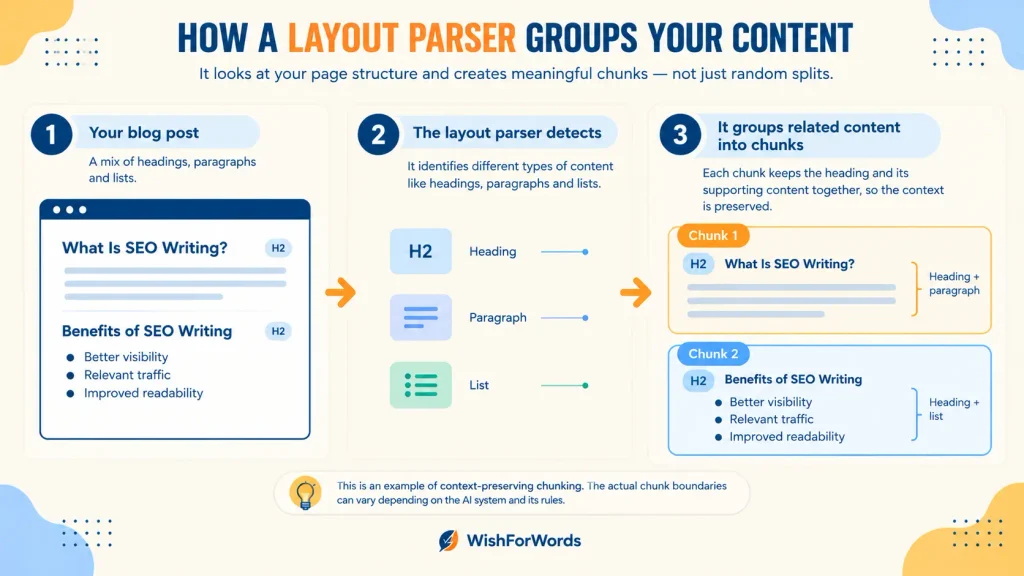
Although Google uses this document-processing method, it doesn’t guarantee that AI Overview, ChatGPT, or any other AI model uses the same approach. But we need to connect the dots to understand the whole picture because no AI model will reveal its full working system. So simply saying that a short paragraph helps AI cite your content is wrong.
Chunking and Short Paragraph
Both the chunking methods point us to two things about paragraph formation-
Short Paragraph– When a paragraph is short and has one core idea, the AI system can divide it into a single chunk with its own context and clear meaning. But a long paragraph has multiple ideas, and AI can split it into multiple chunks, which might cause the chunks to lose context and meaning.
Meaningful Paragraph– Paragraph length alone doesn’t improve citation; it also needs to be a meaningful, structured, and relevant unit (chunk) that the system can understand and extract. So, a sentence like “Semrush helps in keyword research with the heading “Keyword Research” will always be better than a sentence like “it helps in keyword research” without a heading.
What does the Research Say?
There is no solid evidence that short paragraphs alone can increase the chances of AI citation. Research on chunking, how AI scans documents, and how its retrieval system works establishes a relationship between short paragraphs and AI citation.
Short Paragraphs and AI Citation
- Olaf Kopp, an early pioneer of Generative Engine Optimization, notes in his LLM Readability & Chunk Relevance that an average paragraph length of 400 characters makes a passage citation-worthy.
- A Princeton University GEO research paper states that improving the fluency and readability of source text increased visibility in generative answers by 15 to 30%. Short paragraphs also improve readability and fluency.
- SEO researcher Joshua Opolko noted that a passage length of 134-167 words is one of five GEO signals that move citations.
- The paper Document Segmentation Matters for Retrieval states that content segmentation matters. It says larger chunks are hard to scan, and too-small chunks lose context. So, segmentation matters, but it doesn’t specify an ideal paragraph length.
- Daniel Shashko reverse-engineered 42,971 citations and found out that sentences of 6 to 20 words accounted for 92.4% of citations.
Short Paragraph and Human
Small paragraph sizes are preferred not only because AI reads content in chunks, but because humans prefer them, too. Here is what the research says about short paragraphs and reader preference:
- A research paper published in Eyetracker 3 showed that stories with shorter paragraphs received more eye fixations than longer ones. Longer paragraphs discourage viewing.
- The eye-tracking study by Beymer, Russell, and Orton found out that narrow paragraph formatting was linked with faster reading and better information retention.
- A Literature Review found that both very long and very short and very long lines can slow down reading. It recommends an ideal length of 70 characters per line.
But reducing your paragraph length to 60 or 80 words doesn’t mean you will increase your chances of being cited by AI. Research on the Small Chunk Dilemma found that smaller chunks may lose context, leading to incomplete answers.
Another interesting paper is “Lost in the Middle: How Language Models Use Long Contexts,” which is worth discussing. The study found that when relevant information was kept at the beginning of the context, language models performed better.
Here is what we have found till now-
- AI models struggle to scan longer paragraphs.
- Too small paragraphs lose context and don’t serve AI’s purpose.
- Humans read better, and information improves with shorter passages.
- LLMs perform better when you put context at the beginning.
So, what’s the solution? Well, it is atomic writing
Atomic Writing
It is a simple yet effective content strategy that breaks content into smaller, concise, and semantically self-contained units of thought. The five key principles of atomic writing are-
- One Idea per paragraph – Instead of combining multiple ideas into a single paragraph, one should focus on one central idea per paragraph.
- Concise paragraph length – Keep paragraphs short to communicate the idea clearly.
- Lead with claims– Put your main idea, answer, or claim at the very beginning of the paragraph.
- Minimal Dependence– Avoid using nouns that refer to previous paragraphs. Reduce every paragraph’s dependence on the previous paragraph.
Normal Writing
Many aspects of a blog affect its readability. The stats above show that a blog’s readability directly affects SEO. The introduction is another key factor that can make or break your blog’s success. When someone reads a blog, they look at the introduction first; based on the first 50 words, they decide whether to keep reading.
Atomic Writing
A blog’s introduction matters for SEO because it directly affects readability. And how’s readability connected to SEO? The 2025 stats show that blogs with better readability scores performed 10X better in terms of ranking.
Readers also decide whether to keep reading a blog within the first 50 words. A visitor decides within the first 50 words whether to leave your website or keep reading. The first 50 words are your introduction, and if you write it well, it can keep visitors reading.
Can Atomic Writing Be Used Everywhere?
Although atomic writing’s content strategy fits well with the idea of using short paragraphs for AI citation, can you apply it throughout the content?
The answer is NO.
Once you start writing only for AI citation and make atomic writing a rigid rule, your writing quality will degrade. The blog or article will start to sound robotic and lose the continuity, human touch, and unique writing style that keep readers engaged.
So, the simple solution is to use atomic writing for only those parts of your content that you think are AI citation-worthy. Like a solid fact, stats, or a highlight of your content. Draft the rest for humans.
A short paragraph isn’t a magic wand that you will wave and land in AI citation. You need a complete AEO content strategy to improve your chances of AI citation. A short, contextual paragraph filled with a single idea is part of that whole content strategy that makes your content structurally fit for AI citation.