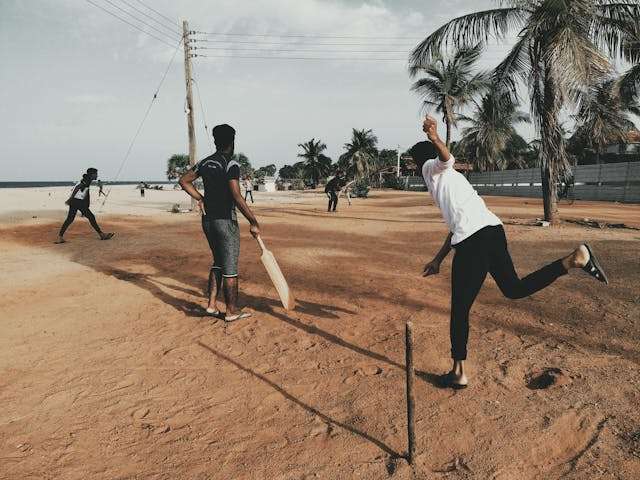
If you are a cricket fanatic, you must have heard of the term “illegal bowling action” at least once in your lifetime.
Whether it was the suspected action of Muttiah Muralitharan during the Australian tour or the banning of the Australian spin sensation Matthew Kuhnemann during the Sri Lanka tour, news regarding illegal bowlers’ action must have popped up in your news feed at least once.
Although most people know that a player suspected of illegal bowling action has to go through assessment, suspension, and remediation. But do you know what the ICC rules are regarding bowlers’ action? What makes a player fall under the radar of illegal bowling action? What is “chucking” or “throwing” in bowling action?
Nobody wishes to go through the PDF files of ICC rule books to understand the basic rules of bowling, and that’s why we have come up with this blog post in which we will talk about bowlers’ action rules in detail. Let’s begin.
What is bowling action?
We have been copying the cricket bowling action of Bret Lee, Dale Steyn, and Harbhajan Singh from our childhood, and that’s why we know what a bowling action is. But to be more specific, bowling action can be defined as
“A set or combination of physical movements a bowler does before releasing a ball.”
Whether it was the stylish and accurate jump of Bret Lee with the bowling hand at waist level and the other hand laser pointing the target, or the opening of hands and then wrapping them around like a bird before landing in the case of Harbhajan Singh, everyone has their unique action.
Types of bowling action
Front on bowling action

This includes the bowler’s chest facing directly towards the batsman. This is why it is considered a direct approach of the bowler towards the crease. It gives better command over accuracy and length. Andrew Flintoff and Makhaya Ntini were two popular bowlers with front on bowling actions.
Side on bowling action
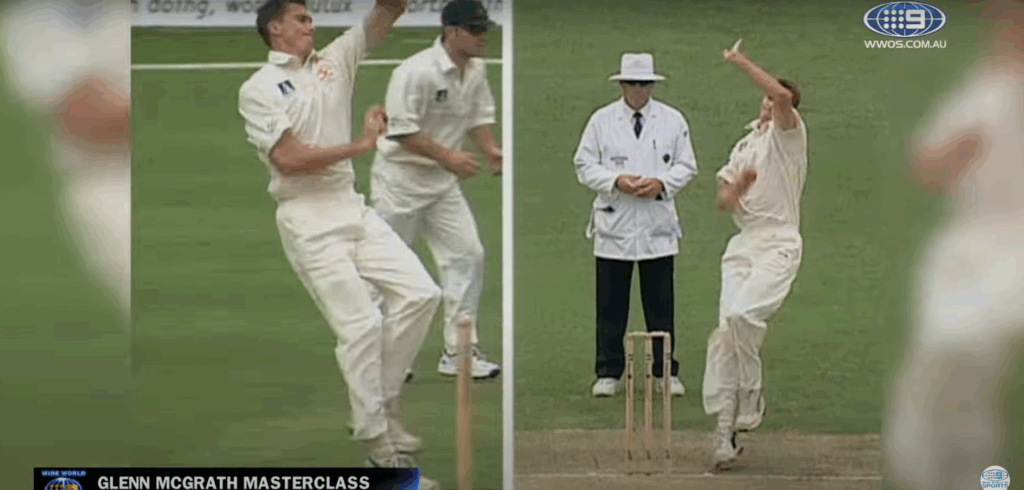
This includes a lateral approach to the crease with a side on motion where the shoulder of the bowler faces the batsman instead of the chest. It gives the bowler seam movement and outswing control. Both Glen McGrath and Bret Lee had side on bowling action.
Round arm bowling action
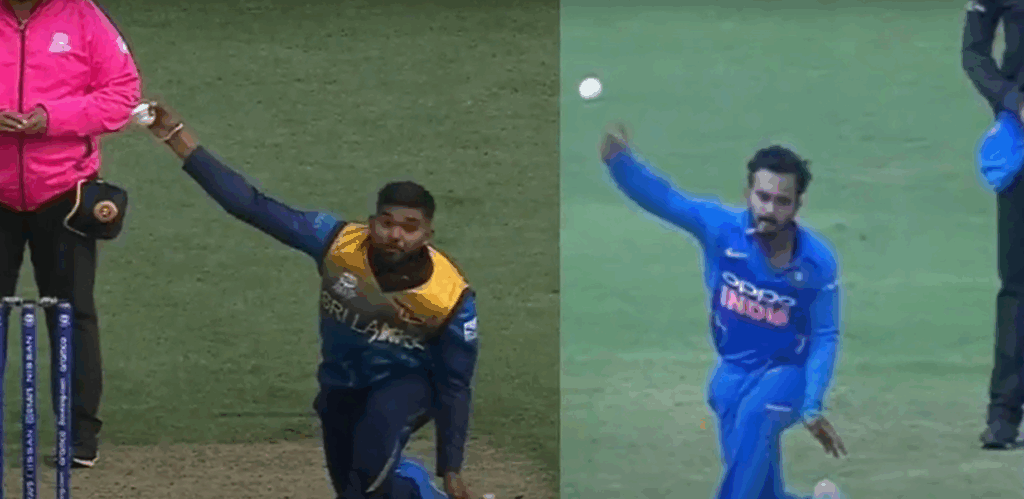
If this type of action gets a little lower, it would be considered underarm bowling. Spinners like Kedhar Jadav mostly use this action. This action offers only a little bounce from the pitch, and since the ball remains low, it becomes difficult for the batsman to hit.
What is an illegal bowling action?
A cricket bowlers’ action is considered illegal if the bowler is throwing the ball instead of bowling the ball. Now, bowling is regarded as a throw when a bowler’s elbow extension goes beyond 15 degrees. This degree is measured from the point at which the bowling arm reaches the horizontal until the point where the ball is released.
The 15-degree rule has been simply explained in this video
Now, many people say that a bowler has been accused of chucking. Don’t get confused as chucking and throwing are often used interchangeably. So, any type of illegal bowling action is called chucking in the cricket realm
The 15-degree rule
According to ICC’s rulebook, a bowler is allowed to increase the velocity of the ball only by rotation of the arm, not by bending the elbow and then straightening it while releasing (as we do while throwing the ball while fielding). But since none of the bowlers out there bowl with a locked elbow, the 15-degree concession was given.
During studies conducted by ICC, it was found that any type of elbow extension becomes noticeable to the eye and looks like a throw when the bending of the elbow exceeds 15 degrees. This is why the ICC came up with the maximum elbow extension of 15 degrees.
It was not always 15 degrees
For centuries, umpires relied on their naked eyes to decide whether a bowler was bowling or throwing the ball. If the umpire felt like the bowler was bending the elbow more than what seemed normal, they would call it a throw. Yes, that was normal until multiple biomechanical tests were conducted.
These biochemical tests revealed that even the most perfect bowling action to the naked eye were found to be technically illegal. These tests also revealed that bowling with or without any type of flex in the elbow is impossible.
After these revelations, the ICC was left with no other option but to come up with new rules. The ICC announced the following elbow degree bends for different types of bowlers
- Fast bowlers- 10 degrees
- Medium pace bowlers – 7.5 degrees
- Spinners- 5 degrees
But these rules were not going to last forever, as a legendary bowler was going to challenge the ICC.
The Muralitharan Mystery
In 1995, when the Sri Lankan team was on an Australian tour, the on-field umpire Darrell Hair declared all six balls of Muralitharan no-balls because of his action. It turned out to be one of the biggest controversies of that time, and from that match, every single ball delivered by Muralitharan was under scrutiny.
According to Darrel Hair, the elbow bend of Murlitharan was more than 10 degrees, and he was using this elbow bend to his advantage. On the other hand, the critics argued that it was a natural elbow bend and there was nothing illegal about it.
But Murlitharan wasn’t ready to surrender to these false claims as he knew that his bowling action was legitimate, and that’s why he went through the biomechanical test. With a clean bowling action, Muttiah Muralitharan was given a clean chit by the ICC. The same test revealed that some of the cleanest bowlers were bending their elbows beyond 10 degrees, and that’s where the amendment came.
ICC was forced to increase the previous 10 degree elbow bend to 15 degrees, and that has remained a standard for bowling action till now.
Top bowlers’ action controversies
Muttiah Muralitharan is not the only bowler who has been accused of chucking. His case changed the rules of the ICC, which is why it has become a cult story in cricket and is still known to everyone.
Other than Muralitharan, many bowlers have been accused of bending their elbows beyond 15 degrees. Some of these bowlers never had to go through any type of test others were not fortunate enough. Here is the list-
- Ajmal Saeed
- Bret Lee
- Shane Warne
- Kemar Roach
- Saqlain Mushtaq
- Jasprit Bumrah
- Shahid Afridi and many more
Any game keeps on improving over time with new talents, techniques, and technology, and that’s what happened to cricket. There was a time when even an underarm delivery couldn’t be called illegal, but things have changed now. The same goes for bowlers’ action.
From judging through naked eyes to using machines and advanced technology to measure the angle of the elbow, cricket has come a long way. The 15-degree angle rule is still in action, and nothing has challenged it till now. Although batsmen have accused bowlers of chucking but if the ICC approves and if the bowler passes the test, nothing can stop the bowler from continuing his action.