
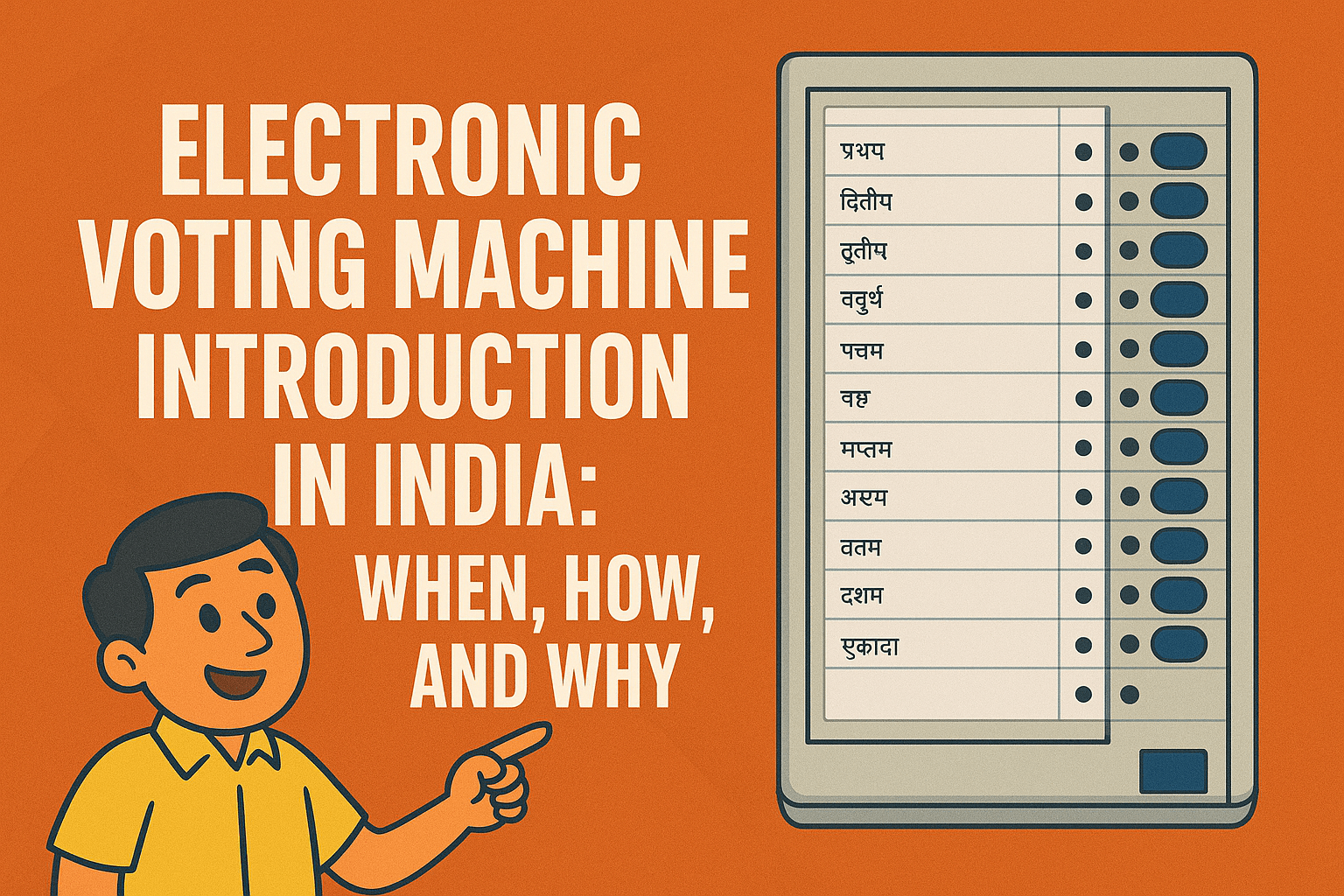
In 1982, the voters of Parur, Kerala, queued to cast their vote for the by-election. As the voting started and people entered the sacred voting room, they discovered that their favorite ballot paper and ballot boxes had been replaced with a compact machine called the EVM. The polling officers were guiding the voters to the alien machine, and every time a voter pressed a button to vote, the machine would make an unusual “beep” sound, which could be heard by voters standing outside in the queue as well. What the voters were witnessing was the first-ever electronic voting machine introduction in India.
It was an EVM trial, and just like this one polling booth, there were 50 other locations in Parur where the EVM was introduced to the voters for the first time in India. This change marked the beginning of a new era, which would allow Indian elections to get rid of ballot paper and ballot boxes forever.
Currently, the 96.8 crore voters of India are used to the “beep” sound of the EVM machine, but little do they know about the why, when, and how of electronic voting machine introduction in India. So, in this blog post, we will delve deeper into the history of EVM and understand its legacy.
When Was EVM Introduced in India?
The EVMs were introduced in India on 6th May, 1982 in Parur (currently known as North Paravur) for the bi-election. Soon, Parur was in every newspaper headline, as this was the first time an electronic voting machine was introduced in India. But this was just a trial run by the Election Commission to understand the effectiveness, safety, and speed of EVM machines.
People’s Reaction
People were amused by the electronic voting machine introduction in India, and especially when their region, Parur, was chosen for trial. The people of Parur were curious yet interested in the new system of voting. To make the trials go smoothly, the polling officers were properly trained to guide the voters to the new machine and voting system.
Legal Obstacles
The aftermath of the electronic voting machine introduction in India wasn’t as smooth as the voting process. Many political parties were against this new system of voting, and even the Representation of the People Act, 1951, recognized only the paper ballot voting system.
This led to the cancellation of the bi-election results as the vote was cast through EVM machines. Although the debut of EVM was appreciated by the voters of Parur and many considered it to be a fast and effective voting method, the law forbade it. But even though the results were cancelled, the Perur EVM introduction paved the way for the adoption of EVM machines in India.
How Was EVM Rolled Out in India?

Amidst protests from political parties and calls for result cancellation, the Election Commission was hopeful of making EVM machines an integral part of India because the trials were successful and voters were appreciating the change.
Law Amendment
The only thing stopping the legal electronic machine introduction in India was the Representation of the People Act, 1951. According to this act, only paper ballots were an acceptable form of voting system. But EVM was destined to become the start of every polling booth, and soon, in 1988, amendments were made, and a new section 61A was introduced. This section made the use of electronic machines legal.
The introduction of section 61A cleared the legal obstacle for the Election Commission, and now they were all geared up to roll out the EVM machines all over India. But they needed a proper rollout strategy as they couldn’t just launch EVM across India and expect it to change the Indian election system overnight.
Broader-Roll Out
A Technical Expert Committee was formed to ensure the smooth introduction of the EVM machine. The goal of this committee was to analyze the EVM machine on every parameter. And when the committee marked EVM machines transparent, safe, and sound, the electronic voting system was introduced on a broader scale during the 1998 assembly election. Slowly, over time, the electronic voting machine introduction in India kept on expanding-
- 1998
EVM machines were used in over 16 Legislative Assembly Constituencies across Delhi, Rajasthan, and MP. It turned out to be a successful trial.
- 1999
It was the first time EVM machines in India were used for parliamentary elections. Over 46 Parliamentary Constituencies successfully completed the voting with EVM.
- 2000
Again in 2000, electronic voting machine introduction in India was expanded by making it a part of the voting system of 45 Assembly Constituencies.
- 2001
EVM machines in India were used for full state-wide elections for the first time. States like West Bengal, Kerala, Puducherry, and Tamil Nadu witnessed the first-ever state-wide electronic voting system.
- 2004
EVMs were used on a full scale during the 14th Lok Sabha elections (2004) as all the 543 Parliamentary Constituencies used the electronic voting system. This turned out to be India’s first-ever nationwide electronic voting. It also made India the first big democracy to conduct a complete electronic election.
Why the EVM Machine Was Introduced in India?
There is not a single reason that turned India into an electronic voting nation, as many factors contributed to this shift. Here are some of those factors
Colossal electorate
Back in 1980, India had 542 constituencies and 35.62 crore voters. India stood out from other countries in terms of its voting system and managing such a huge voting system on paper was a logistical and management nightmare.
Voting Fraud
Booth capturing was a big problem in India, and the introduction of the electronic voting system completely wiped such malpractices from the voting system. With EVM in place, booth capturing will just lead to cancellation of voting in that region, and no tampering.
Speed
Counting lakhs of ballot papers delayed the results; sometimes it took a week. But electronic voting machine introduction in India allowed the EC to declare the results within hours of polling day.
Environmental Factor
Printing lakhs of ballot papers and managing documentation on paper during the election season was taking a huge toll on the environment. This issue was also addressed by EVM as it made the election system paperless.
Wrapping It Up
In just 30 years, the Election Commission realized the grave need for a complete transformation of the election system. The EVM was new, and launching it to a nation with a population of 72 crore was not an easy task. But with proper planning and clearing the legal obstacles, the ECI transformed the Indian voting system forever. Although the safety of EVMs is still questioned in every election (no proof yet), even after 43 years of their introduction, no one doubts the speed and efficiency it has brought to the election system.
FAQs
Q. Who made the first EVM of India?
The first prototype of EVM machine in India was made by a PSU, Electronics Corporation of India Ltd that worked came under Department of Atomic Energy.
Q. Who manufactures evm in India?
The two public sector undertakings Bharat Electronics Limited (BEL) and Electronic Corporation of India Limited (ECIL) currently manufacture EVM machines in India.
Q. Who invented evm machine in the world?
There is no single person who can be considered as the inventor of EVM as the credit goes to a group of USA and Europe (Netherlands) based companies. In 1892, Jacob H. Myers of Rochester patented the first ever mechanical voting machine in New York and therefore he can be called the father of voting machines. And Then in 1969, Bertarm W. Barger and Howard C Strauss worked on the first ever electronic vote recorder. Later, different countries came out with their own version of EVM machines.
Q. Which country invented evm machine?
Both USA and Netherlands can be considered as the pioneers in EVM machine as they were the first countries to use EVM.
Q. Can EVM machine be hacked?
Although EVM machines are specially designed to restrict any kind of tampering but just like all other software solutions, there are potentials of being misused. This does not mean a claim of hacking.
Q.Why Parur was chosen for EVM introduction?
The selection of Parur for EVM introduction in India was not random; it was strategic. Kerala had a high literacy rate, and the Election Commission believed that making people of Parur understand the working of EVM would be easy. Also, Parur had a history of high voter turnout, and the total number of voters was less. All this made it easy to manage the trails of the EVM machine in India.