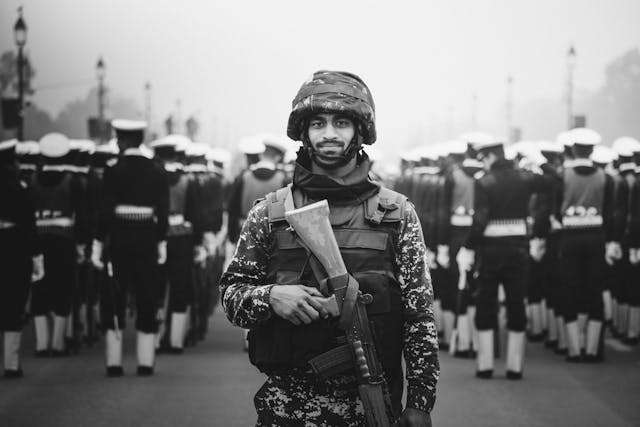
War brings along battles on every front, and some of those battles are so decisive that they can turn the entire war upside down. One such battle is the Battle of Longewala 1971 when a battalion of just 120 Indian soldiers hammered an entire brigade of 3000 Pakistani soldiers and 40 tanks.
“Soldiers do not fight because they hate what is in front of them. They fight because they love what is behind them.” – G.K. Chesterton.
This quote fits like a glove in the Longewala war since for every 25 Pakistani soldiers, India only had one soldier, and every three Indian soldiers had to deal with a tank as well. But when odds are high against you, courage and bravery become your ultimate weapon, and that’s what made the 23rd battalion of the Punjab regiment win against all odds.
But what was the motive behind attacking Longewala, and how did India respond? Well, we are going to cover every angle of the heroic Battle of Longewala 1971 in this blog post.
Indo-Pak War 1971
Before understanding the 1971 war longewla, it is necessary to know the bigger picture- the Indo-Pak war 1971.
Due to the atrocities of the Pakistani army in East Pakistan (now Bangladesh), the number of refugees entering India surged to a whopping 1 crore. This was the time when India, under the leadership of Indira Gandhi, realized that going to war with Pakistan was a better option than sheltering 1 crore refugees.
And when the Pakistani Air Force attacked Indian Airbases, Indian finally declared war on Pakistan. At that time, Pakistani president Yahya Khan was waging war against India with the doctrine “The defence of East Pakistan lies in the west”.
Pakistan’s Thunder Run in The Battle of Longewala 1971
Yahya Khan knew that East Pakistan couldn’t be defended, and even if he started a war with India, it wouldn’t last long because of international pressure. So, he planned to start with India, capture as much land as possible and then use the occupied Indian territory on the bargaining table for the losses suffered in East Pakistan.
The Pakistani army took cover of darkness and marched on the dark dunes of Longewala on 4th December 1971. The Longewala Post was guarded by the 23rd Battalionthe of the Punjab Regiment under Major Kuldip Singh Chandpuri. A battalion of 120 men against a complete Pakistani brigade of 3000 soldiers and 40 tanks. This was the Battle of Longewala 1971.
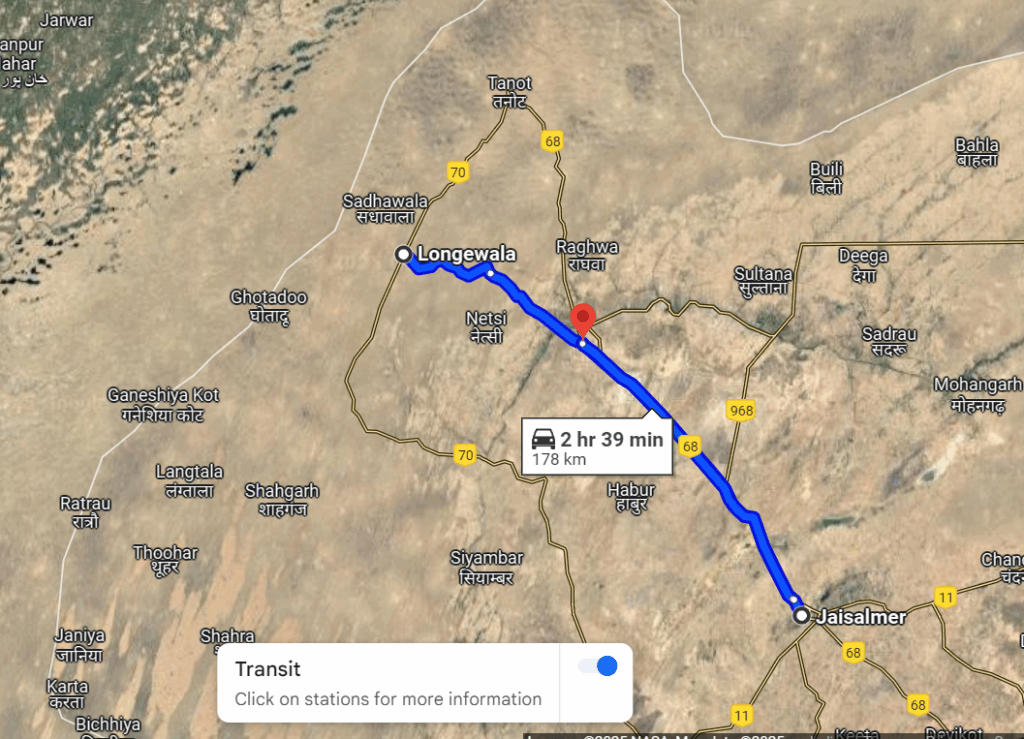
Pakistan had plans to have breakfast in Longewala, lunch in Ramgarh and dinner in Jaisalmer.
Why Pakistan Attacked Longewala in 1971?
There are three main reasons why Pakistan chose the Longewala Post for such a massive attack:
Ganganagar Advantage
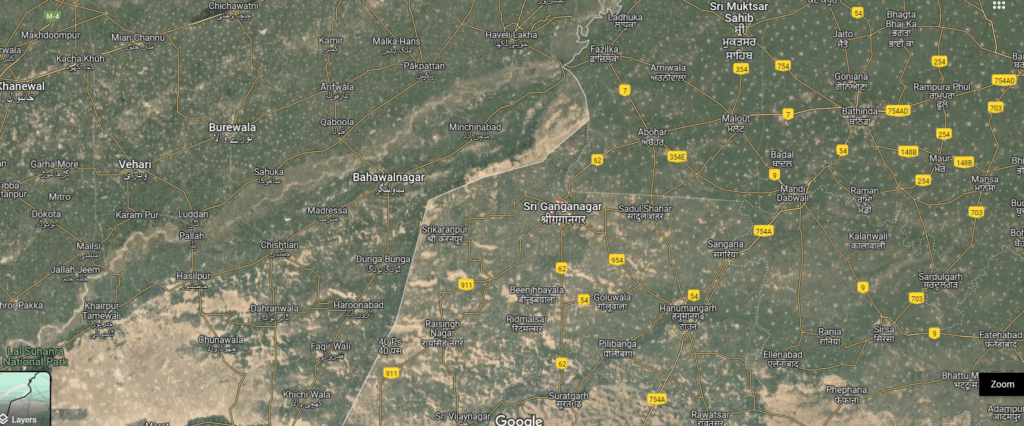
Ganganagar was a district in Rajasthan located near the Indo-Pak border, and Pakistan had intentions of capturing it with the help of its 1st armored division (a military unit that even participated in the India Pakistan war 1971 Longewala).
But a strong hold on Ganganagar district required complete road and supply control, and to do so, capturing Longwala, Ramgarh, and Jaisalmer was necessary. Capturing these three cities will completely cut off India from the western part of Rajasthan, and that’s what Pakistan wanted.
Protection of North-South Road Link
The North-South Road Link, particularly the Grand Trunk Road, connected West Pakistan with East Pakistan. And, since it acted as the only lifeline between the two halves of Pakistan, it became a matter of strategic importance. Also, protecting this route would have prevented India from using it as a ground to attack Pakistan.
Capturing Longewala, Ramgarh, and Jaisalmer was a part of the North-South Road Link protection strategy. Once acquired, the route could have been used for supplies and troops through road and rail.
Territorial Bargain
Another reason for Pakistan to attack Longewala, India, was to later use the captured land to bargain for the losses Pakistan had suffered in the east. Pakistan thought that India had deployed its full force on the borders of East Pakistan, and they could use the vacuum created on the western borders of India to attack the Longewala post.
Pakistan knew that they couldn’t do much in East Pakistan, and the only way they could negotiate with India was to capture their land through the west and then sit at the bargaining table after the war to ask for compensation or anything Pakistan wanted.
Even India knew that if Pakistan occupies Longewala, no one can stop it from reaching Jaisalmer.
The Battle of Longewala 1971
The Longewala Post
The Longewala post was a BSF post which was later assigned to the 23rd battalion of the Punjab regiment because of the Indo-Pak war 1971. India knew the strategic importance of this post, but enemies attacking this post was a far-fetched idea even for Indian officers.
Indian Defense
A major part of the Indian armed forces was deployed on the East Pakistan borders since it was the center of the war. This left the Longewala post with only 120 men of both the BSF and the 23rd Battalion of the Punjab Regiment. This battalion also had
- Two medium machine gun
- Two 81 mm mortar
- Four anti-tank launcher
- One Jonga-mounted M40 recoilless rifle
- Camel Border Security Force Division
Pakistani Offence
- A strong brigade of 3,000 soldiers from 4 different regiments
- 40 Tanks (Chinese T-59 and US-built Sherman)
The strong Pakistan’s brigade was divided in three parts
- 38 cavalry and 206 brigade (Goal- Capture Longewala)
- 22 cavalry and 38 Baloch (Goal- Move towards Ramgarh)
- 51 brigade (Goal- Follow follow troops moving towards Ramgarh)
The Longewala War- D Day
4th December 1971
Discovery and Brave Decision
On the cold night of 4th December 1971, Dharm Veer Singh was patrolling the border with his 20 men when he heard the noise of tanks crossing the Indian border. He immediately informed Major Kuldip Singh Chandpuri about the movement of Pakistani troops.
Chandpuri then contacted the battalion headquarters and asked for reinforcement since he knew that his regiment’s size wasn’t enough to defend the post. The headquarters gave him the option to defend the post or retreat to Ramgarh, as reinforcement couldn’t reach Longewala that night.
But Major Kuldip Singh Chandpuri took the brave decision to stay at the Longewala post and defend it at any cost.
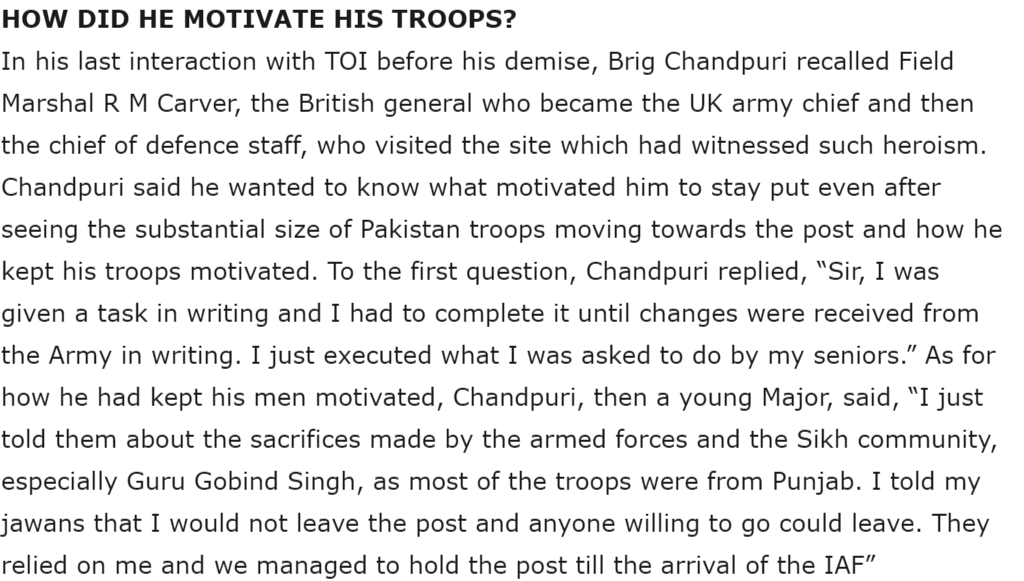
Major Kuldip Singh Chandpuri knew that his men needed motivation to face such a huge enemy brigade and to keep the spirits high and motivate his men, this is what Major Chandpuri said before the battle:
The Dark Dunes Dazzled With Light
Around 12:30 AM, the Pakistani troop opened up their artillery. This instantly killed 5 camels of the Camel Border Security Force Division. In haste, the Indian troops began laying anti-tank minefields, and while laying the minefields, one of our soldiers was martyred.
But the tanks were still far away from the Longewala Post, and because of this slow progress, even the 22nd Cavity and 38th Baloch were assigned a new task of capturing Longewala instead of moving to Ramgarh.
The 38 cavalry of the Pakistani Brigade which included T-59 tanks and Sherman tanks,, were moving like sloths in the sand because they were not designed for such operations in the desert, and therefore, many tanks got stuck in the sand, and many were damaged.
The Indian troop at Longewala post held their fire until the tanks were not more than 15-30 meters from the post. This was a strategic move because they wanted the tank to come under the range of anti-tank launchers and one Jonga-mounted M40 recoilless rifle.
As the tanks of the 38th cavalry came under the specified range, Indian troops rained fire through the M40 and anti-tank launchers. This instantly destroyed two of the Pakistani tanks. Firing from the M40 proved to be highly effective because of the elevated position of Indian troops.
The thinner top layer of the Pakistani tank became an easy target and the bombing ignited the extra fuel tank at the top of the tank, which lit the entire area and made the Pakistani troops visible.
The Barbed Wire and Beyond
The 22nd cavalry and 38th Baloch were slogging through the sand with their new mission of capturing Longewala. But as they came close to the post, their movement came to a halt as they saw barbed wire laid down just before the Longewala post.
The single barbed wire laid by Indian troops to stop camels from going further into the desert. But the Pakistani army thought that there were anti-tank mines beyond the barbed wire, and that’s why they first called engineers and then brought in sappers to clear the anti-tank mines.
The Pakistani troops spent almost 2 hours scanning the area beyond the barbed wire for anti-tank mines, and this made it easy for the Indian soldiers at the Longewala post to take an upper hand in the battle of Longewala 1971.
When the Pakistani soldiers were just 15-20 meters from the Longewala post, the Indian soldiers opened heavy fire. This heavy attack startled the Pakistani troops, as nothing was going as planned for them.
5th December 1971
Hail fire and Hunters
By the morning of 5th December 1971, the Indian soldiers had destroyed 12 Pakistani tanks and killed many soldiers. Still, the Pakistani soldiers were far ahead in numbers, and many of their tanks were still operational.
But the sun rising from the horizon of Thar desert not only brought light and day but also brought along a new hope for the Indian troops in the form of the Indian Air Force. At around 7:30 AM, the HAL HF-24 Maruts and Hawker Hunter fighter jets of the Indian Air Force reached the Longewala post and joined the Longewala war.
These fighter jets were not equipped with night vision, and that‘s why they had to wait till dawn to join the Longewala battle during the Pakistan and India war 1971.
The Indian fighter jets hammered the Pakistani tank and troops with rockets. The IAF successfully destroyed 4 Pakistani tanks and killed many soldiers on their first run.
First run- IAF fighter jets used to go back to Jaisalmer for refueling and rocket restocking and then came back to attack at the Longewala post.
Sitting Ducks, Regrouping and Backup
The attack by Indian fighter jets was so fierce that the entire Pakistani troop got scattered and took shelter wherever possible. The machine guns mounted on the tank were ineffective against the fighter jets. Also, the clear terrain and no backup of the Pakistani Air Force made the Pakistani army sitting ducks for IAF jets. The Indian officers described the attack as “Turkey Shoot”.
But as soon as the fighter jet’s hellfire stopped, Pakistani troops regrouped and resumed their attack on Longewala, and the Indian army realized that the Battle of Longewala 1971 was not over yet. On the other hand, the Pakistani army thought that the jets would not return, but both HAL HF-24 Maruts and Hawker Hunter fighter jets were refueling and restocking rockets at Jaisalmer to go back and resume the attack at Longewala.
By 8:00 AM, reinforcement arrived at the Longewala post in the form of the 12th Infantry Division of the Southern Command. This division consisted of soldiers and more than 15 tanks, and the infantry was led by Col. Bawa Gurbachan Singh. Soon, the 17th Battalion Rajputana Rifles also joined the Longewala post in the form of additional reinforcement.
By the afternoon of 5th December, the Pakistani brigade had lost 36 tanks. 22 of them were destroyed by the IAF and 12 by anti-tank fire.
6th December 1971
The Bitter Truth and Tariq Mir
The Pakistani generals sitting in the office were not ready to gulp down the bitter truth that such a huge Pakistani army with 40 tanks was pushed back by India. So they ordered Tariq Mir (Officer leadin,g the Pakistani brigade) to drop the plan of going to Ramgarh and Jaisalmer. He was asked to move with full force and capture Longewala, but Tariq Mir replied
“Our army is not enough to even reach Longewala, so it’s very difficult to move ahead”
At night, two more regiments were sent to Longewala to support the remaining Pakistani troops on the battlefield. At around 3:00 AM, Tariq Mir was ordered to provide support to the already damaged 22nd cavalry squadron. But Tariq Mir knew the situation and didn’t move forward to support 22 cavalry squadron. He was all ready to retreat with his 51st Brigade.
Realization
Even after suffering heavy losses, Pakistani generals decided to order the remaining troops to move towards Ramgarh and Jaisalmer. But the dawn of the 6th December brought along whispers of realization for Pakistan. The Pakistani generals finally realized that they had lost the battle.
No surprise as it always takes time for Pakistanis to accept defeat, sometimes days and in some cases, decades.
The remaining Pakistani troop was ordered to retreat, and Indian troops defended the Longewala post in the most heroic way possible. This was a huge blow to Pakistan as their dream of having breakfast in Longewala, lunch in Ramgarh, and dinner in Jaisalmer was shattered, and they returned to their nation hungry, wounded, and demotivated.
Conclusion
The Battle of Longewala 1971 is one of those fierce battles that clearly shows, when it comes to war, numbers never matter. If you know yourself, your terrain, and your enemy, you can hammer them in any condition, in any situation and at any time, and this is what the 23rd Battalion of the Punjab Regiment under the leadership of Major Kuldip Singh Chandpuri showcased.
Major Kuldip Singh Chandpuri was later awarded with Mahavir Chakra, India’s second-highest gallantry award and several other members of the battalion were also awarded. Without such brave soldiers, even discussing a defense of 120 men against an offense of 3000 men would have been out of question.
It doesn’t matter how many years passes, how many battles we fight, the dunes and sand of Longewala will always scream out the courage and bravery Indian forces shown at the Longewala war.